
What a Scent Exhibition Teaches a Buyer About Lead Times
A scent exhibition looks like a creative project and behaves like a manufacturing one. It has a fixed opening date, content that must be frozen before the space can be built, materials with their own lead times, and a long list of trades that can only be sequenced in one order. That is close enough to a fragrance order that walking an exhibition with a production schedule in mind teaches a buyer more about lead times than another supplier presentation would.
Key takeaways
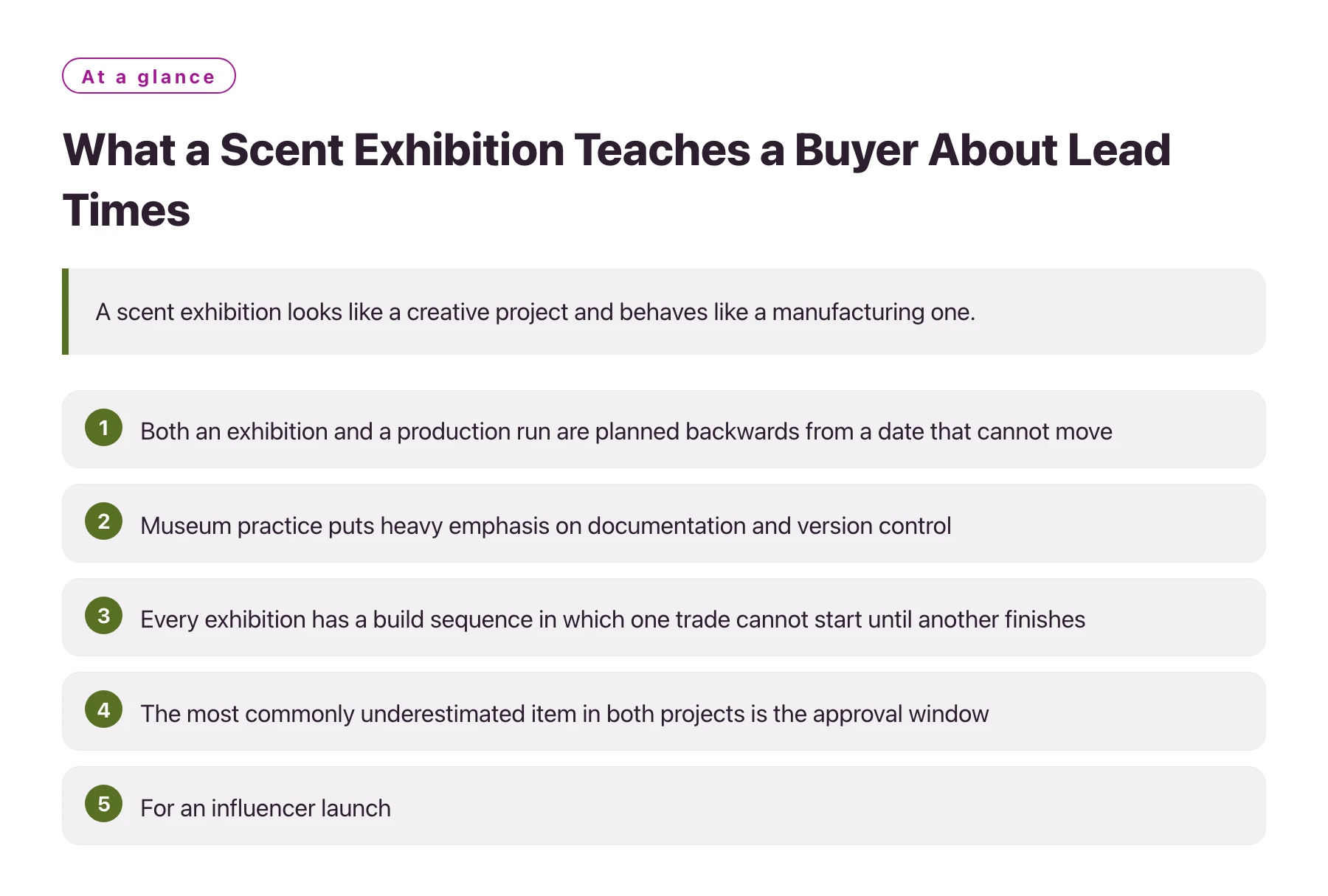
- Both an exhibition and a production run are planned backwards from a date that cannot move, and the first planning error in each is the same: announcing the date before the content is frozen.
- Museum practice puts heavy emphasis on documentation and version control, which is exactly what a fragrance project needs when a label, a formula and a bottle change at different speeds [1].
- Every exhibition has a build sequence in which one trade cannot start until another finishes; a fragrance order has the same hard order between formula freeze, testing, decoration and filling.
- The most commonly underestimated item in both projects is the approval window, because time spent waiting for a sign-off is invisible on a plan and real on a calendar.
- For an influencer launch, the exhibition parallel is the useful one: the public date should be set after the internal freeze, not before it [2].
A first-time founder visiting a scent exhibition usually goes for the smells. The interesting part, if a launch is being planned, is everything else: how the rooms are lit, how the route is controlled, and how many times the same object appears in different forms because one version was not ready in time.
Exhibition teams are professional planners of a specific kind. They work backwards from an opening date, they know which decisions freeze content, and they are ruthless about version control because a caption printed twice is a visible error. A fragrance project has the same structure with different nouns: captions become labels, rooms become formats, and the opening date becomes the drop date.
This article draws the parallel deliberately, because most first-launch delays are planning errors rather than production errors. A supplier that quotes twelve weeks is quoting a sequence; a buyer who understands that sequence can see where the twelve weeks go, and where the plan is likely to break.
Four exhibition decisions and their production equivalents
| Exhibition decision | Fragrance production equivalent | Where the weeks go |
|---|---|---|
| Fixing the content list before the space is designed | Freezing the formula version before packaging design starts | Redesign after a content change is the most expensive kind of rework in both projects |
| Ordering long-lead materials early | Booking glass, pumps and cartons against a forecast rather than an approved sample | Materials with long lead times can be ordered before approval only if the risk is priced in |
| Sequencing trades that cannot overlap | Running stability and compatibility testing before decoration and filling | Testing is calendar time, not effort, and it cannot be compressed by paying for speed |
| Controlling caption and signage versions | Keeping label artwork and ingredient declaration in step with the formula version | A mismatch found after printing costs a reprint and a new production slot |
| Rehearsing the opening | Running a pilot batch and comparing it with the retained reference | The rehearsal is where coordination problems surface while they are still cheap |
Read as a list of warnings, the table is really one warning repeated: the order of operations is not negotiable, and money buys capacity rather than sequence. A supplier that presents from formula to finished bottle as a series of gates is describing this order, and the gates are what a buyer should be planning against.
The freeze point is the decision that sets the date
Exhibitions have a moment, usually well before the public opening, when the content stops changing. After that point, changes carry a cost that grows with every day. Fragrance projects have the same moment, and it is the approved sample: after it is signed, the formula is fixed, the testing can run, the decoration can be scheduled and the labels can be finalised.
The mistake is announcing the date first. A creator who tells an audience the drop is in ten weeks creates a constraint that the project has not earned yet. If the fifth sample round reveals a problem, the announcement becomes the problem, and the pressure moves from the factory to the brand.
The practical alternative is to publish a window rather than a date until the approved sample exists, then convert it. It is a small marketing compromise that removes an enormous amount of schedule risk.
Approval windows are real time
Exhibition planners treat sign-off as a task with a duration. Fragrance projects often treat it as an event that takes an afternoon. In practice, a sample sent for approval may sit in an office for a week, be tested on skin over several days, and be discussed before anyone writes back.
The fix is simply to put the approval window on the plan as blocked time. A sample that arrives on a Friday and is approved the following Wednesday has cost three working days, and that is normal rather than a failure.
What to look for on a factory visit
Museum standards and professional guidance emphasise documented process, condition records and controlled versions, which is a useful lens for a factory visit [1]. The question to carry around a plant is not how impressive the machinery is but how many handovers a project passes through, because each handover is a place where a version can drift.
A second question is who keeps the reference sample and where. In an exhibition, the object that visitors see is the controlled version; in production, the retained reference is the controlled version, and it is the only object that can settle a disagreement about the bulk order.
It is also worth asking how a change is logged. Exhibition teams record every version because a printed caption cannot be edited after opening. A factory that records formula and artwork versions has the same instinct, and the record is what makes a second order uneventful [2].
A backwards plan a first-time founder can write in an afternoon
- Start from the drop date and subtract the approval windowTreat approval as three to five working days of blocked calendar, not as an instant response.
- Subtract testingStability and compatibility work needs calendar time in the actual base and packaging. Ask the supplier for the duration before the brief is written.
- Subtract decoration and fillingIf the bottle carries any decoration, that schedule runs in parallel with testing but not with formula changes.
- Subtract the sample roundsCount the rounds that will actually be needed, including one extra for the audience test, and add the approval window to each.
- What is left is the brief deadlineIf that date is already in the past, the launch date is the problem, not the factory. Working under one programme, with fragrance manufacturing under one roof, removes the coordination gaps but cannot remove the sequence.
The useful habit to take away from an exhibition is the rehearsal. A scent exhibition runs a full dry run before anyone is invited; a fragrance order benefits from the same thing in miniature. Ask a supplier to run a pilot batch and compare it against the approved reference before the full run is committed. It costs a small amount of money and a small amount of time, and it is the cheapest way to find a coordination problem. Visiting a museum built around smell with that question in mind is more productive than visiting it for inspiration alone.
Sources
- ICOM — International Council of Museums —— The international organisation representing museums; publishes the ICOM museum definition and professional standards for museum practice.
- Museums Association —— A professional body for museums, publishing guidance and research on museum practice and visitor experience.
Frequently asked questions
How long should a first custom fragrance order be planned for?
The range is wide because it depends on format, decoration and markets, but a first order with a custom scent, a decorated bottle and testing is usually measured in months rather than weeks. The reliable way to get a number is to ask a supplier to break its quoted lead time into stages and to identify which stages run in parallel.
Can lead time be shortened by paying more?
Partly. Capacity can sometimes be prioritised, and decoration can be scheduled sooner. Testing and approval are the two stages that resist money, because stability work needs elapsed time and approval needs a human decision. Compressing those stages usually means accepting more risk rather than buying speed.
What is the most common scheduling mistake on a first order?
Setting the public launch date before the sample is approved. Everything downstream — content, pre-orders, announcements — is then scheduled against a date the project has not yet earned, and every later surprise becomes public.
Does a scent exhibition have anything to teach about packaging?
It teaches version control most directly. Exhibitions cannot reprint a caption after opening, so the approved version is locked and every change is logged. A perfume label works the same way, and treating the artwork as a controlled version rather than an editable file prevents the most common pre-launch reprint.
How does this change for an influencer launch specifically?
The launch has an audience that expects to be told something early, which adds pressure to announce before the project is frozen. The workable compromise is to communicate progress and the scent direction while keeping the date flexible until the approved sample is signed.